
The basic rules
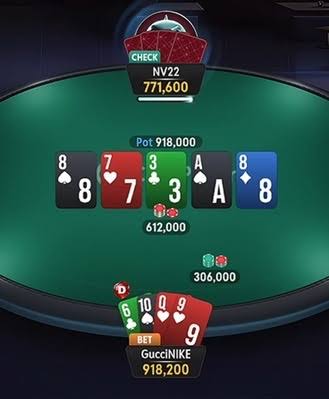
Each player receives two hole cards that only they can see. Five community cards are dealt face up in stages. You make the best five-card hand from your seven, and the strongest hand takes the pot.
| Stage | Community cards | What happens |
|---|---|---|
| Preflop | None | Hole cards dealt; betting starts left of the big blind |
| Flop | Three | Second betting round, starting with the small blind |
| Turn | Fourth card | Third betting round |
| River | Fifth card | Final betting round, then showdown |
← swipe the table →
On each round you may fold, check, call or raise. Once someone has bet, checking is no longer available — you fold, call or raise.
Hand rankings
| Rank | Hand | Description | Example |
|---|---|---|---|
| 1 | Straight flush | Five consecutive cards of one suit | A♠ K♠ Q♠ J♠ T♠ |
| 2 | Four of a kind | Four cards of the same rank | 9♠ 9♥ 9♦ 9♣ 2♠ |
| 3 | Full house | Three of a kind plus a pair | K K K 7 7 |
| 4 | Flush | Five cards of one suit | A♥ J♥ 8♥ 5♥ 2♥ |
| 5 | Straight | Five consecutive cards | 8 7 6 5 4 |
| 6 | Three of a kind | Three cards of the same rank | Q Q Q 9 4 |
| 7 | Two pair | Two separate pairs | J J 6 6 A |
| 8 | One pair | A single pair | T T A 7 3 |
| 9 | High card | Nothing made | A Q 9 6 3 |
← swipe the table →
Short Deck removes the deuces through fives, leaving 36 cards. Flushes become harder to make, so a flush beats a full house. Straights come in more easily and the ace plays low as a five. Re-learn the order before you sit down.
Position: the most underrated edge
Position is where you act in the betting order. Later is better, because you have already watched everyone else decide.
| Position | Short | Suggested opening range | Why |
|---|---|---|---|
| Under the gun | UTG / EP | About 15–18% | Five players still to act — stay tight |
| Middle position | MP | About 20% | Slightly wider |
| Cutoff | CO | About 28–30% | Where stealing begins |
| Button | BTN | About 40–45% | Best position, widest range |
| Small blind | SB | About 30% | Poor position but already invested |
| Big blind | BB | Defend, not open | One blind already committed, so defend wide |
← swipe the table →
If you change one thing, tighten under the gun and widen on the button. Most beginners play a similar range everywhere, and correcting only that measurably reduces losses.
Working out pot odds
Find the pot you are calling into
Pot of 100, opponent bets 50 → you are calling 50 into 150.
Convert to a percentage
50 ÷ 150 ≈ 33%. That is the equity you need.
Estimate your equity
Quick method: outs × 4 from flop to river, outs × 2 from turn to river. A nine-out flush draw is about 36% on the flop.
The ×4 rule overstates equity unless you are all in. With betting still to come, be conservative.Compare the two numbers
36% beats 33%, so the call is mathematically justified. Below it, fold.
A postflop thinking framework
After the flop, do not ask “do I have a hand?”. Ask three questions in order:
- Who does this board favour? A K 7 favours the preflop raiser; 6 5 4 with two of a suit favours the caller.
- What role is my hand playing right now? A value hand wanting calls, a bluff wanting folds, or a hand to give up on.
- What is my bet trying to achieve? If you cannot name who you want to call and who you want to fold, check instead.
Taking one pair to the river every time. In a multiway pot on a dangerous board, one pair is a medium-strength hand at best. Learning to release medium hands when opponents show strength is worth more than any bluffing technique.
Glossary
| Term | Meaning |
|---|---|
| BB / SB | Big and small blind — forced bets, and the unit stacks are measured in |
| EP / MP / LP | Early, middle and late position |
| Range | The full set of hands an opponent can hold in a given spot |
| Equity | Your probability of winning against an opponent's range right now |
| C-bet | Continuation bet — the preflop raiser betting again on the flop |
| 3-bet | A reraise over an opening raise |
| Pot odds | The price of a call as a share of the pot |
| Implied odds | The additional chips you expect to win after hitting your draw |
| ICM | Independent Chip Model — converting tournament chips into real prize value |
| Tilt | Playing badly because of frustration rather than reasoning |
| Rake | The fee the platform takes from the pot |
| Rakeback | A portion of that rake returned to you |
| Freeroll | A tournament with no buy-in |
| Bad beat | Losing after being a large favourite |
← swipe the table →
Rules learned — now practise
Get comfortable in a free environment first. Before real-money tables, understand rake and rakeback.
18+ | Affiliate link | Please play responsibly
Frequently asked questions
What beats what in Hold'em?
From strongest: straight flush, four of a kind, full house, flush, straight, three of a kind, two pair, one pair, high card. Short Deck is the exception — with the deuces to fives removed, flushes are rarer, so a flush beats a full house.
How many hands should I play preflop?
At six-handed, roughly: 15–18% under the gun, 20% in middle position, 40–45% on the button, 30% from the small blind, and a wider defending range in the big blind. The classic beginner error is playing a similar range from every seat.
Why does position matter so much?
Because you act after your opponents and therefore decide with more information. The same KJ is a clear raise on the button and a clear fold under the gun. The hand did not change — the position did.
What are pot odds?
The price of a call relative to the pot you are calling into. With 100 in the pot and a bet of 50, you risk 50 to win 150 — about 33%. You need more than 33% equity for the call to make sense.
What should I be thinking about after the flop?
Three questions in order: who does this board favour, is my hand a value hand or a bluff right now, and who am I trying to make call or fold? If you cannot answer the third, checking is usually correct.
Where can I find the terminology?
There is a glossary further down this page covering BB, EP/MP/LP, c-bet, 3-bet, range, equity, ICM and tilt.
How long does it take to learn?
An hour for the rules, a month for basic strategy, and usually several months of deliberate practice before you stop losing consistently. The real dividing line is not knowledge — it is whether you can keep executing your plan during a downswing.